
What Is Kintsugi?



What Is Kintsugi?
Kintsugi is the Japanese art of repairing. This art suggests what’s broken can become more beautiful because of it.
The word kintsugi literally translates to “golden joinery.” Originating in Japan, this centuries-old practice repairs broken pottery by filling cracks with precious metals, transforming damage into a focal point rather than something to conceal. The result is not a return to the original, but something entirely new.
It’s a therapeutic means of fixing what’s broken. And while the art and practice itself entails fixing broken pottery with gold, silver, or lacquer, really it’s an ideology that offers a form of healing. Essentially, you treat cracks not as flaws to hide, but as history worth honoring. At its core, kintsugi is about fixing what’s broken without erasing what happened. It’s a beautiful, some would say healing and revealing practice, a philosophy. More poetically put, it’s a quiet invitation to see ourselves differently when life fractures us.
It’s the idea of embracing the wounds and treating them with love and tender care for optimal repair rather than hiding and pushing them down.
What in your life can you apply the ideology of Kintsugi to?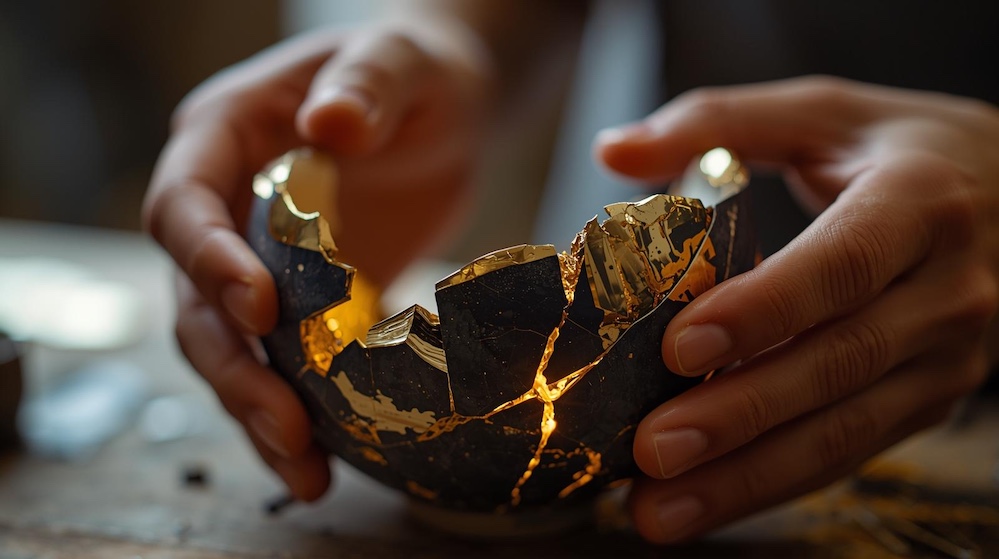
The Art of Kintsugi
Kintsugi is a fine art, much like other Japanese modalities and design aesthetics. It’s slow, deliberate, and offers a sense of deeper clarity. Like Reiki, which I have been practicing for 15 years as a Reiki Master, it is intentional, requires focus, and offers healing and an awakening.
Kintsugi very much is based on a similar ideology. It’s slow. It’s highly focused, but not high stress. It’s intentional without the anxiety of needing to get to some finish line at some record pace. It’s slow and thoughtful, not to mention a deeply meaningful practice.
Unlike the West, where there is pressure to perform, compete, and keep up with the Joneses, the philosophy behind kintsugi feels grounded. The Western world often looks down upon what’s broken and things that are cracking. We lean more toward a philosophy of perfectionism and concealing cracks. That also goes hand in hand with concealing feelings, trauma, and generational pain at times. Until recently, therapy, especially for men, has been frowned upon, suggesting there is something wrong with you rather than viewing it as a way to heal, improve, and feel whole again, which are all positive things.
As far as an art form, visibility matters. Art is made for the sole purpose of sharing, showing, observing, appreciating, displaying, laying bare. In this particular practice, visibility in kintsugi is the whole purpose. It’s the idea that broken things can be fixed and can still be beautiful and admired and revered. It’s the whole purpose of this Japanese art form.
Why Kintsugi Doesn’t Hide the Cracks
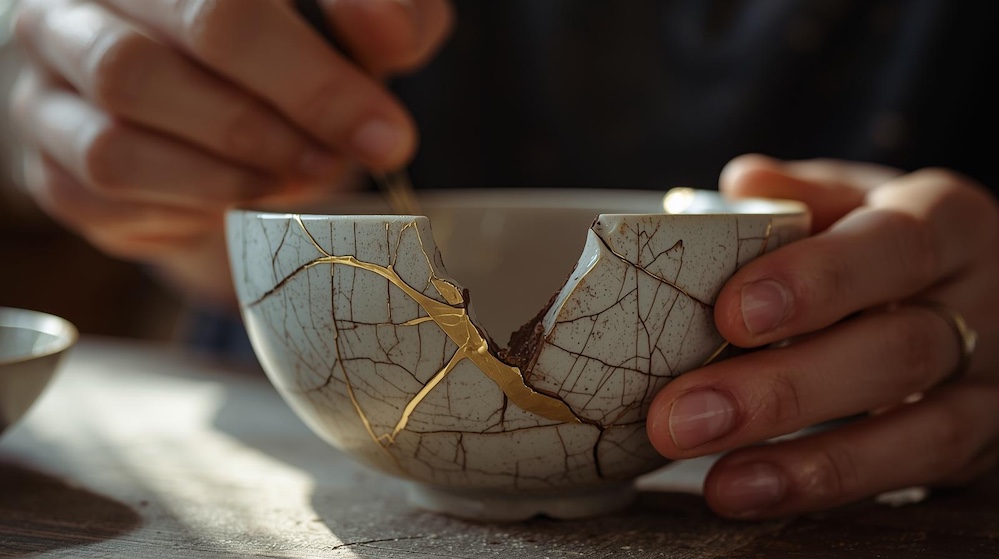 The philosophy of kintsugi is a beautiful one. The idea is not to hide the cracks. It’s to highlight the damage rather than conceal it or cover it.
There’s an unspoken power in showing up flawed, or with your heart on your sleeve, so to speak. It’s an opportunity during the practice to see the magic and power of revealing yourself in a sort of purity and uncovered glow. It’s the real you, and it affirms that healing is possible.
Cracks can be put back together, and that does not take away from the aesthetic or beauty of it, but in some cases even enhances it. So is the case with us in life. Our cracks reveal who we really are and allow us to show up authentically rather than inauthentically.
Healing isn’t reversible, nor should your wounds and suffering be contained and caged up. It’s there. It happened. We can’t take that back.
Kintsugi as a Metaphor for Vulnerability
In this way, kintsugi art comes across as a metaphor for vulnerability. It’s a shift from pottery or art into something far more cathartic. It awakens healing without loudly professing it. In a soft and subtle way, you are allowed to explore your vulnerability as exposure rather than a form of weakness.
All experiences in life leave marks. And we carry those forward. The more we hold them front and center, the more healing there is, the more freedom we experience and express, and the less guarded we become.
Recognize this in yourself. Think of all the times you opened up and shared a little softer side of yourself and how freeing and liberating that was. I’m sure you’ve felt validated and liberated by the receptiveness of a loved one who simply held space for your moment of vulnerability in a way that leaves you feeling full and open to going deeper rather than closing up and putting up walls.
Broken Isn’t the Opposite of Whole
There’s a quiet but important misunderstanding embedded in how we talk about healing that wholeness means unbroken. As if to be whole is to have no fractures, no scars, no visible history. But that idea doesn’t hold up under real life.
Often, what looks whole on the surface is simply unexamined. Untouched. Unrevealed.
Kintsugi challenges that assumption. It suggests that transformation and repair are not opposites. That something can be changed and still carry its fractures forward. Healing does not erase what happened. It integrates it.
We don’t become whole by pretending we were never broken. We become whole by allowing our experiences, especially the painful ones, to become part of who we are, rather than something we disown. Meaning doesn’t arrive in spite of fracture. It accumulates through it.
Authentic Kintsugi Pottery vs. Imitation
Authentic kintsugi pottery is not simply about appearance. Traditionally, it involves repairing broken ceramics by hand, using natural lacquer and precious metals like gold or silver. The process is slow. It can take months. Each stage requires patience, care, and attentiveness.
Many modern interpretations mimic the look, gold-colored lines painted on intact pieces, or decorative cracks added for effect. These versions aren’t wrong, but they are different. What’s missing is intention.
Kintsugi, at its core, is not about surface repair. It’s about relationship to time, to damage, to process. In that way, it becomes a quiet metaphor for healing that goes deeper than aesthetics. There’s a difference between appearing healed and being integrated.
What Kintsugi Teaches Us About Self-Worth
Kintsugi holds a subtle but powerful message about worth: that it is not erased by damage.


The repaired vessel is not considered less valuable because it broke. In many cases, it becomes more cherished. Not because the break was desirable, but because it was met with care, attention, and respect.
There is something grounding in this idea. That visibility doesn’t diminish us. That honesty doesn’t make us fragile. That lived experience, especially when acknowledged, adds depth rather than taking something away.
When we stop trying to appear unbroken, we make space to be real. And in that space, worth becomes something quieter, steadier, and less dependent on performance.
Practicing the Spirit of Kintsugi in Life
Kintsugi doesn’t offer a method to follow or a checklist to complete. It offers an orientation.
An invitation to stop rushing repair.
To let experiences be integrated rather than hidden.
To allow patience to be part of healing.
Not everything needs to be resolved. Some things need to be held.
FAQ
What does kintsugi symbolize?
Kintsugi symbolizes the idea that breakage and repair are part of an object’s and a person’s story. Rather than hiding damage, it honors it, suggesting that what has been broken and mended can carry greater meaning and beauty because of its history.
Is kintsugi an art or a philosophy?
It’s both. Kintsugi is a physical art form rooted in Japanese craftsmanship, but it also carries a philosophical perspective about imperfection, impermanence, and repair. The practice and the philosophy are intertwined.
Why does kintsugi resonate so deeply?
Because it reflects something universally human. Everyone carries cracks, loss, grief, mistakes, change. Kintsugi offers a language for acknowledging those experiences without shame, and a way of seeing value where we’re often taught to see failure.
Conclusion
Kintsugi doesn’t promise restoration to what once was.
It offers something quieter and perhaps more honest. A way of seeing that allows cracks to remain visible. A reminder that repair doesn’t have to erase history. An understanding that beauty, depth, and meaning often arrive not before the break but through the care that follows it.